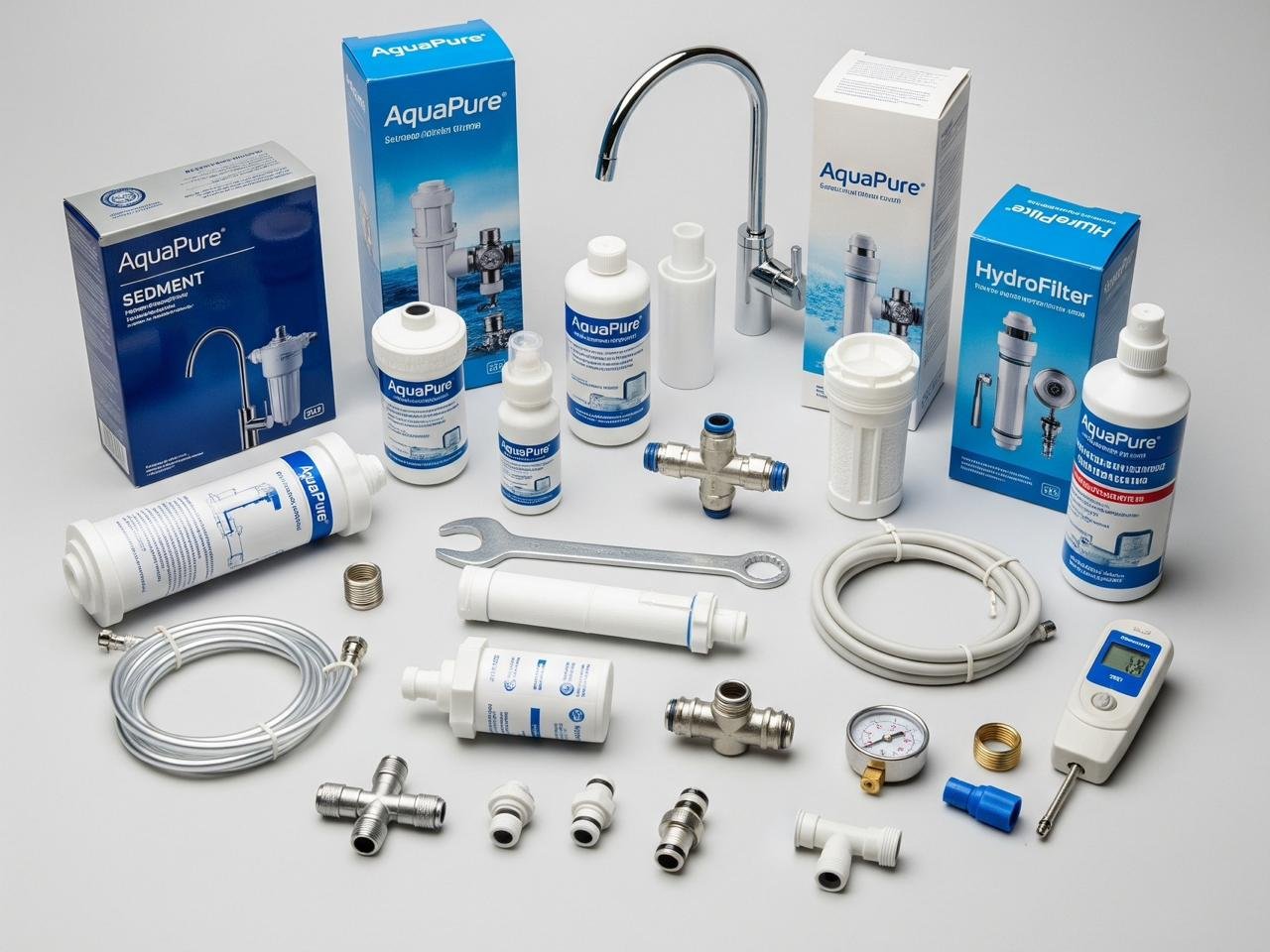
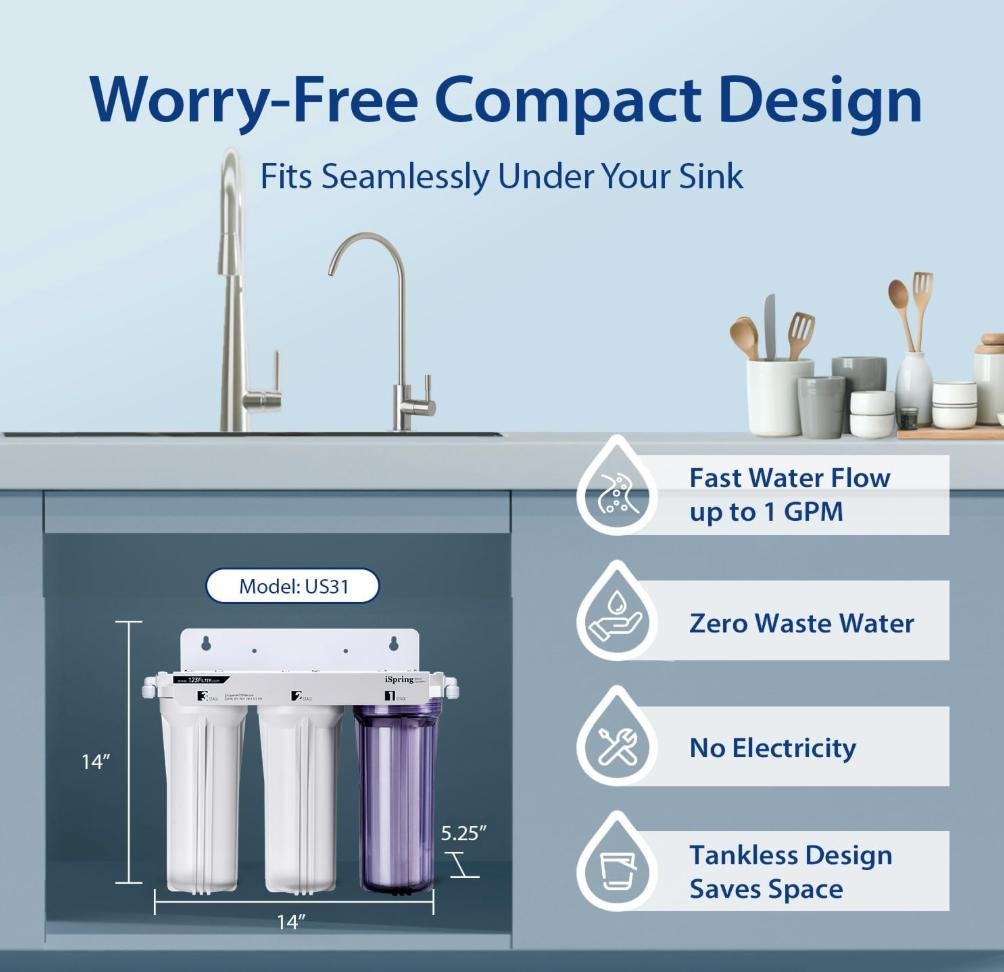
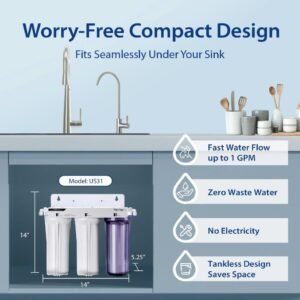
A water purification system relies on the seamless coordination of various high-precision components. To help you understand their specific roles, our accessories are categorized into four core systems: Filtration, Power & Control, Water Circuit Connection, and Peripheral Terminal Components.
1. Core Filtration System (The “Heart”)
Filters are the most critical components determining water quality, with each type serving a distinct purpose.
- PP Sediment Filter (Polypropylene)
- Function: Coarse filtration. It traps large particles such as sand, rust, red worms, sediment, and suspended solids from tap water.
- Lifespan: 3 – 6 months.
- Granular Activated Carbon (GAC) / Carbon Block (CTO) Filter
- Function: Adsorption and dechlorination. Utilizing the high porosity of carbon, it removes residual chlorine, unpleasant colors, odors, pesticides, and volatile organic compounds (VOCs).
- Lifespan: 6 – 12 months.
- RO (Reverse Osmosis) Membrane
- Function: Ultimate purification. With a filtration accuracy of 0.0001 microns (\mu m), it effectively eliminates bacteria, viruses, heavy metals (such as lead, arsenic, cadmium), and Total Dissolved Solids (TDS). It is the most vital and premium component of an RO system.
- Lifespan: 24 – 36 months (depending on local water quality).
- UF (Ultrafiltration) Membrane
- Function: Mineral-retaining filtration. With an accuracy of around 0.01 microns, it removes bacteria and macro-molecules while retaining natural minerals. (Note: It cannot remove heavy metals or limescale/calcium ions).
- Lifespan: 12 – 24 months.
- Post-Activated Carbon Filter (T33 / Taste & Odor Filter)
- Function: Taste enhancement. Positioned as the final stage, it polishes the water to remove any residual taste from the storage tank, making the water crisp and sweet.
- Lifespan: 12 months.
2. Power & Control System (The “Brain & Muscle”)
For electrical water purifiers (such as RO machines), these components provide the required driving force and automatic logic control.
- Booster Pump
- Function: Pressure generation. Since RO membranes require high pressure to overcome osmotic resistance, the booster pump provides the necessary mechanical pressure (typically 0.5 – 0.8 \text{ MPa}) to push water molecules through the membrane.
- Power Adapter (Transformer)
- Function: Voltage step-down. Converts household 220\text{V}/110\text{V} AC power into safe 24\text{V} or 36\text{V} DC power to drive the pumps and solenoid valves.
- High-Pressure & Low-Pressure Switches
- Low-Pressure Switch: Water shortage protection. Automatically cuts off power when source water is shut off or pressure drops too low, preventing the booster pump from idling and burning out.
- High-Pressure Switch: Full-tank auto-shutoff. Cuts off power when the storage tank is full or the faucet is closed, stopping the system from generating excess wastewater.
- Solenoid Valves (Inlet & Flush)
- Inlet Solenoid Valve: Controls water entry. Opens when energized and shuts when powered off, preventing source water from bypassing into the drain when the machine is idle.
- Auto-Flush Solenoid Valve: Automatically triggers high-flow rinsing of the RO membrane surface to wash away scaling and prolong the membrane’s service life.
3. Water Circuit Connection System (The “Blood Vessels”)
Ensures leak-free performance under prolonged high-pressure conditions.
- PE Water Tubing
- Specifications: Commonly available in 1/4-inch (O.D. approx. 6.35\text{mm}) or 3/8-inch (O.D. approx. 9.52\text{mm}).
- Material: Food-grade polyethylene (PE), offering excellent pressure resistance and burst prevention.
- Quick-Connect Fittings
- Types: Straights, Elbows, Tees, Check Valves, Y-connectors, etc.
- Features: Tool-free push-fit design with internal EPDM O-rings. Premium locking claws ensure zero leaks under high pressure.
- Feed Water Adapter & Ball Valve
- Function: Splices into the main household cold-water line to divert water into the purification system, allowing independent shut-off for maintenance or filter replacements.
4. Peripheral Terminal Components
- Drinking Water Faucet
- Types: Lead-free Stainless Steel (SUS304) or Solid Brass.
- Upgrades: Smart electronic faucets featuring real-time TDS displays and filter life indicator rings are increasingly standard.
- Water Storage Pressure Tank
- Function: Buffer storage. Standard low-flow RO systems (50\text{G} – 75\text{G}) produce water slowly. The pressure tank stores purified water in an internal food-grade bladder under pressurized air, ensuring high flow rates when the faucet is turned on. (Note: Tankless configurations with large-flow RO membranes do not require this).
- Flow Restrictor (Wastewater Ratio Valve)
- Function: Controls the pure-to-waste water ratio by restricting the drainage rate, creating the necessary back-pressure inside the RO membrane housing.
💡 Sourcing & Selection Guidelines
- Safety Certifications: All components in direct contact with water (especially filters, tubing, and fittings) must carry food-grade certifications (such as NSF/ANSI standards, WRAS, or FDA compliance) to ensure no leaching of chemicals or heavy metals.
- Sizing Standards: Double-check Imperial (1/4″, 3/8″, 1/2″) versus Metric sizes to avoid cross-threading or improper tubing fits during assembly.
- Tier-1 OEM Suppliers: For core reliability, opt for industry-standard brands for critical parts—such as RO Membranes (e.g., DuPont/Filmtec, Hydranautics, Vontron) and Booster Pumps (e.g., Dengyuan, Grand Forest).
Are you currently sourced for aftermarket replacement parts for maintenance, or are you managing a supply chain/sourcing project for a water purifier assembly line?
Contact Us Now from WhatsApp!